|
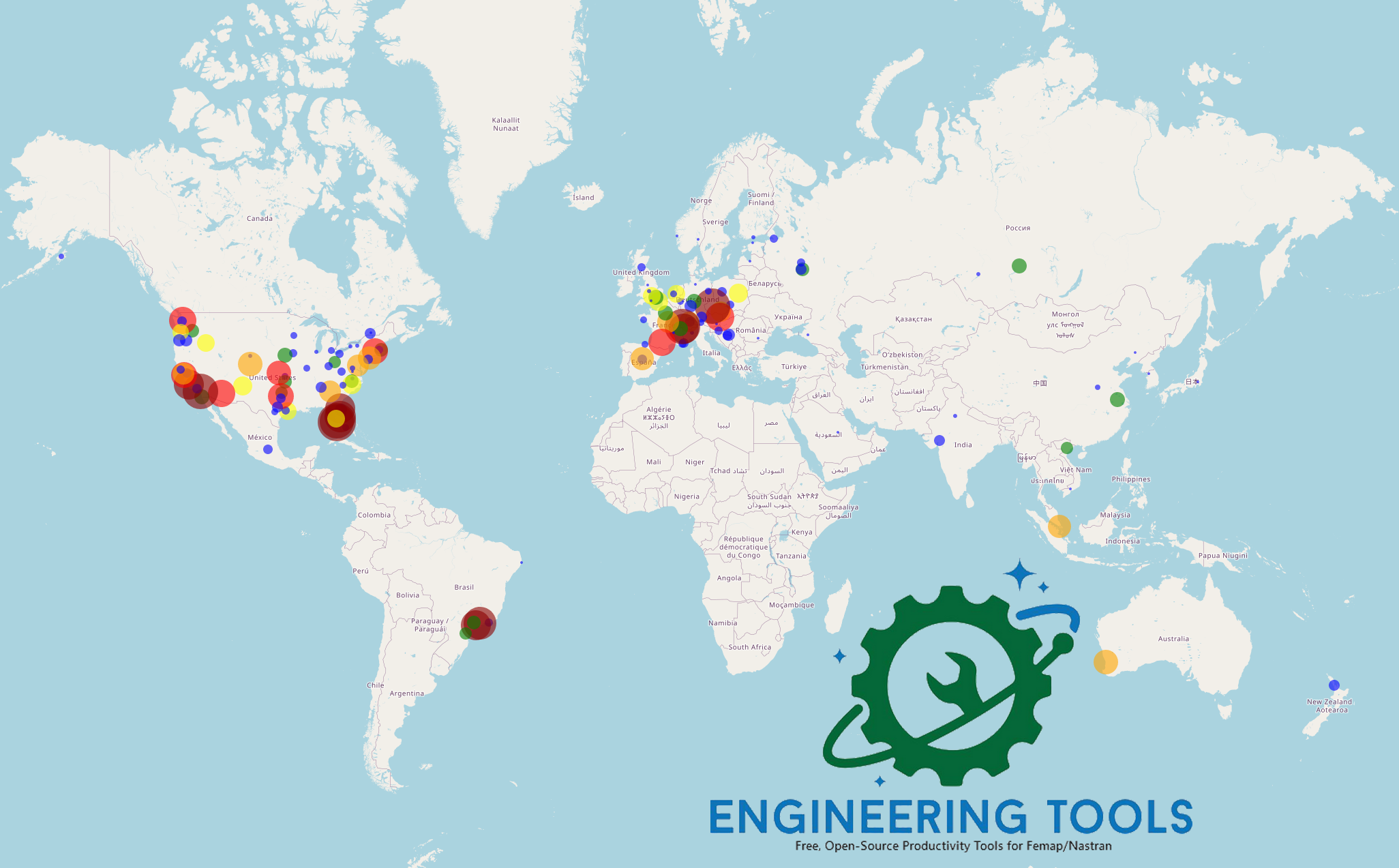
Take your engineering game to the next level! Join engineers worldwide in harnessing the power of engineering automation to boost productivity and achieve superior results. In less than 5 minutes, unlock new possibilities and elevate your productivity. These are where engineering tools are being used around the globe. Ready to join us and revolutionize your approach? Let's engineer success together.
by Ian Rivard, SeStructures LLC — May 2026 I get asked variations of the same question all the time. “What size model should my workstation handle?” “Are we behind the curve running half-million-node decks?” I’ve been doing FEMAP scripting and structural FEA for over two decades now, working with aerospace primes, new space, and defense contractors. Engineering Tools has a lot of users across that spectrum, and over the years I’ve talked with a lot of them about how they work. None of these observations are scientific — but the patterns hold across companies and across tool types. Here’s what I see in 2026, and how it’s shifted since I started. Two industries, one toolkitBefore I dig into the observations: the most useful frame I’ve landed on is that the structural FEA community I see is really two distinct communities sharing a lot of the same software. On one side: traditional aircraft and air-vehicle work — the primes, the legacy programs, the lifing-and-fatigue engineers. Static stress, fatigue analysis, classical structural certification. Workflows that have been refined over forty years, locked in by DERs and validation requirements. Slow to change tools because the tools are part of the certification basis. On the other side: new space — satellite primary structure, launch vehicles, smaller aerospace shops, the constellations. Heavily dynamics-driven (random vibration, modal survey, shock response). Younger workflows, less legacy weight, more willing to adopt new tools because they’re not validating against forty years of process. These two communities answer almost every question about “the industry” differently. When I say something like “frequency response is the dominant workflow,” that’s true and not true depending on which side of that line you’re standing on. The new space side runs modes-and-random for a living. The aircraft side runs static stress and fatigue for a living. Both are right; they’re just doing different jobs. Models have gotten bigger — but not in the way you'd expectWhen I started, a “real” production model was 50,000–80,000 nodes. A half-million-node model was a flagship, and you ran it over the weekend. Today, the boring-day-to-day model is more like 100,000–200,000 nodes. The flagship has crept up to a couple million. Roughly one in four sessions I see involves a model with more than 500K nodes. That used to be “the big one.” Now it’s just the Tuesday job. What isn’t changing is that elements are still mostly Quad4 plates. Shell-dominated structural FEA hasn’t been disrupted by all the compute we’ve thrown at it — engineers just put more shells in. The “let’s switch to all-solid second-order tets” revolution that everyone predicted ten years ago hasn’t really happened in production work. Tet10 is up, but Quad4 still outnumbers every other element type by an order of magnitude in the work I see. If you’re sizing a workstation, the rule I tell people is: 32 GB of RAM is the floor for anything serious, 64 GB is the typical sweet spot, and 128 GB is normal for the heavy users I work with. I have people running 256 GB on truly large models. The crossover happened maybe four or five years ago. Composites are everywhere nowThe biggest workflow shift I’ve watched, by a wide margin, is the spread of composites. A decade ago, composite layups were a specialty — you saw them at the big aerospace OEMs, a couple of motorsport teams, maybe a wind-turbine shop. Most engineers I worked with did metallics and never touched a layup property card. Today, somewhere around 40% of the structural models I see have at least one composite layup defined. Aerospace structure is using it. Automotive structure is heading there. Even bracket and fitting work is increasingly hybrid (sandwich panels, bonded inserts, co-cured stiffeners).
Frequency response is the silent majority — for new spaceIn the work I see, frequency response and modal analysis together are the dominant workflows — by a significant margin over linear static. Random vibration is the next-biggest. Linear buckling shows up regularly. Nonlinear-static is a real but minority workflow. Heat transfer? In four years of conversations with FEMAP users, I’ve talked to maybe three people who were doing serious thermal in FEMAP. But that’s heavily new-space-flavored. The legacy aircraft side of the industry runs a very different mix: linear static for the bulk of stress work, fatigue analysis (often outside FEMAP proper), occasional modal for flutter and ground-vibration, and the nonlinear cases where they matter. Static stress isn’t dying — it’s still the foundation of every certification report on every production aircraft. It’s just that the analysts doing it tend not to be the early adopters of free FEMAP scripting toolkits. What that means practically: if you’re training the next generation of analysts, the answer depends on which industry you’re training them for. New space wants modal mass participation, mode tracking, frequency-response post-processing, and PSD analysis. Legacy aerospace wants static stress, hand-checks, fatigue spectra, and a deep relationship with the certification basis. Both are legitimate career paths. Neither is going away. The mistake is assuming your industry’s defaults are universal. FEMAP versions: a slow marchI see users on every FEMAP version from 11.0 up to the current release. That’s over eleven years of versions still in active use, in the same engineering community. What I'd tell a new structural analyst
|
|
|
|||||||||||||||||||||||||||||||||||||||||||||||||||||||||||||||||||||||||||||||||||||||||||||||||||||||||||||||
|
|||||||||||||||||||||||||||||||||||||||||||||||||||||||||||||||||||||||||||||||||||||||||||||||||||||||||||||||